How an automotive hose is built
A typical hose has a media-resistant inner tube, a reinforcement layer for strength and a cover that resists the environment — together they keep the hose reliable in demanding conditions.
Technology
Understand hose construction, materials and testing — and get expert support.
Materials guide
| Material | Temp. range | Key properties | Recommended media |
|---|---|---|---|
| EPDM | -40 to +150 °C | Aging, ozone and coolant resistant | Coolant, hot water, air |
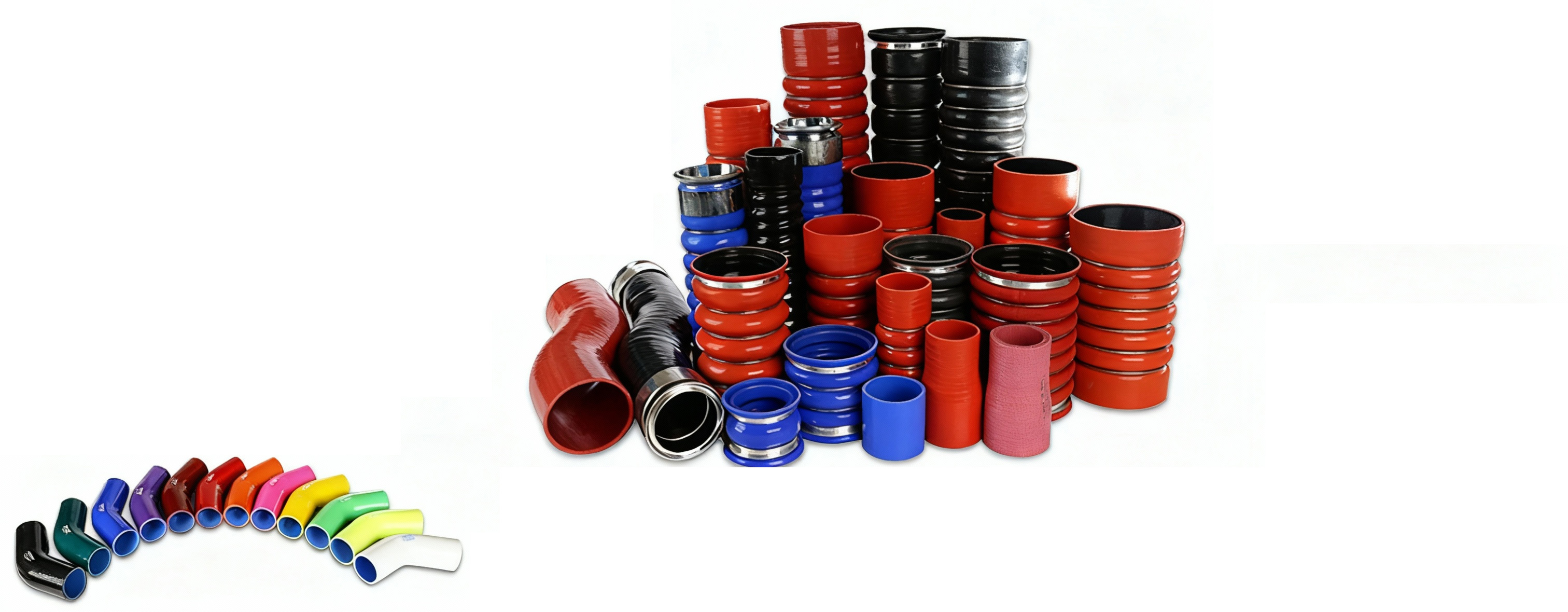
| VMQ silicone | -60 to +250 °C | Extreme temperatures, aging resistant, colorable | Charge air, coolant |
| NR (natural rubber) | -50 to +80 °C | High resilience, fatigue resistant, bonds to metal | Anti-vibration parts, boots (not oil resistant) |
| NBR (nitrile) | -30 to +120 °C | Excellent oil resistance | Fuel, lube oil, oil vapor |
| FKM (fluoroelastomer) | -20 to +230 °C | Oil, chemical and heat resistant | Fuel, oil mist (often as liner) |
| CR (neoprene) | -35 to +120 °C | Weathering and flame resistant, balanced | A/C, protective covers |
| AEM (ethylene acrylic) | -40 to +175 °C | Hot-oil and heat resistant | Turbo oil return, PCV |
| PA (nylon) | -40 to +120 °C | Strong, light, fuel resistant | Quick connectors, inserts |
* Typical industry values; actual performance depends on the specific compound and testing.
Quality testing
ID, OD, wall thickness, length and bend angles verified.
Strength confirmed at rated pressure with safety margin.
Pressure cycling simulates long-term service.
Hardness and tensile changes measured after heat aging.
Surface cracking checked in an ozone atmosphere.
Bend test at low temperature to confirm no cracking.
Insights
A typical hose has a media-resistant inner tube, a reinforcement layer for strength and a cover that resists the environment — together they keep the hose reliable in demanding conditions.
A thermostat switches coolant between a small loop and a large loop through the radiator, keeping the engine at its optimum operating temperature.
Charge air is hot and pulsating. Silicone stays elastic at high temperature while multi-ply reinforcement provides the burst strength needed for intercooler lines.
FAQ
Send us the model, year, OE part number or VIN and our technical team will match the correct hose. You can also send a sample for us to measure.
Tell us the application, media, temperature and pressure requirements. Our engineers will reply with a proposal and quotation within 24 hours.